

27 Sep
2026
Last Updated: September 27, 2026
Can fashion choices improve self confidence? Research into enclothed cognition suggests they can, because the clothes you wear change how you think and perform (pubmed.ncbi.nlm.nih.gov). This guide from Upstormed breaks down the psychology, the practical steps, and the budget-friendly ways to dress with intention in 2026.
Enclothed cognition is the psychological effect where the symbolic meaning of clothing influences the wearer's mental state and performance. What you wear sends a message inward before it ever sends one outward, and that idea sits underneath nearly every credible answer to whether fashion choices can improve self confidence.
Most style guides treat dressing well as a performance for other people. The more useful frame runs the opposite direction: your wardrobe is a daily routine you control, and self-perception responds to it long before anyone else reacts.
You are not chasing approval. You are building a visual identity that reinforces your own sense of self-assurance, one outfit at a time.
The classic enclothed cognition examples come from experiments where participants wore a white coat described either as a doctor's coat or a painter's smock. The same garment produced different results depending on the story the wearer believed. The coat didn't change. The meaning did.
Clothing carries symbolic weight, and your brain acts on that symbolism. A structured blazer reads as authority; a soft knit reads as comfort. Neither is objectively "confident," but your nervous system assigns a role to each.
This is why color psychology and mood, and fit and self-esteem, keep showing up in research and everyday experience.
Personal style is the consistent set of choices that make your wardrobe feel like yours, and you can find it without replacing everything you own. The goal is recognition, not reinvention. Most people already dress in a way that works; they just haven't named it.
Women's Skinny Yoga Pants for Sports →
Pull three to five outfits you actually feel good in and look for the pattern: a silhouette, a color family, a fabric weight, a level of structure. Those recurring elements are your style anchors.
Once you have your anchors, write one sentence describing them, something like "structured tops, soft bottoms, muted colors, one bold accessory." It's not a rule but a filter: if a purchase doesn't fit it, it probably won't get worn, no matter how much you like it on the rack.
Buy one piece at a time and wear it in a low-stakes setting first. Overhauling the whole closet in one trip often ends with half of it not fitting your real life. Test, observe how you feel, and keep only what earns its place.
Personal style discovery often ignores how a garment actually feels. For many people, including those with sensory processing differences, scratchy seams, tight waistbands, or stiff collars are a constant distraction no styling can overcome. Treat comfort as a non-negotiable anchor: softness, stretch, and breathable materials are the foundation of a wardrobe you'll actually wear, and only a wardrobe you wear can do any confidence work.
Finding your style does not require spending. Your anchors are descriptions, not shopping lists. Apply them to what you already own, then fill gaps one piece at a time, often through thrift, resale, or a single well-chosen addition. The point is recognition and repetition, not acquisition.
A confidence-boosting wardrobe is a curated set of pieces that fit well, match your style anchors, and get worn often, buildable on a modest budget by prioritizing fit and frequency over volume. Budget-friendly confidence building is about spending where the payoff is highest.
A capsule wardrobe is a small, coordinated collection of versatile pieces that mix and match into many outfits. The framework forces every purchase to earn its spot, which keeps a budget intact.
| Capsule Layer | What to Include | Why It Builds Confidence |
|---|---|---|
| Base pieces | Well-fitting pants, tees, and knits | Removes daily decision fatigue |
| Structure pieces | One blazer or defined jacket | Signals authority and competence |
| Statement piece | One printed or textured item | Adds self-expression and identity |
| Footwear | Two pairs that fit perfectly | Grounds the whole outfit |
Fit is the single highest-use variable in how clothing affects self-esteem, because a garment that follows your actual shape removes the low-grade distraction of constant adjusting. When clothes fit, you stop thinking about them. That mental space is where confidence lives.
Women's Skinny Yoga Pants for Sports →
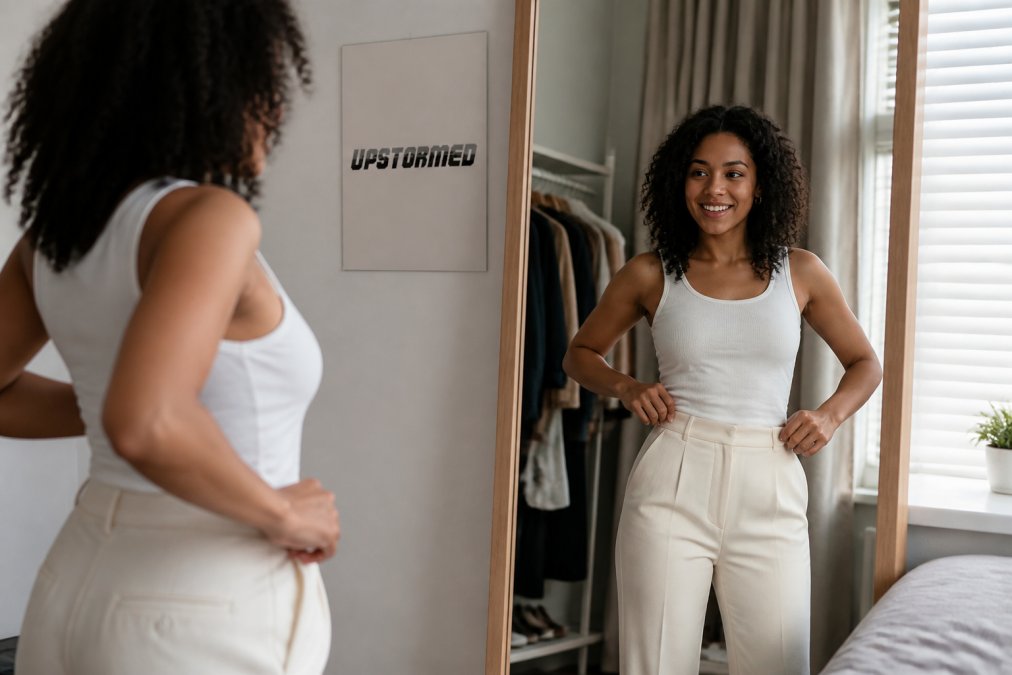
Color psychology and mood are linked in a practical, personal way: colors carry associations you've built over a lifetime, and dressing in them can shift your emotional state. There is no universal "confidence color," despite what trend articles claim. The associations are yours.
Instead of memorizing a color wheel, run a simple inventory:
You do not need a new wardrobe to test color. A single scarf, a pair of socks, a bag, or a lip color can introduce a new shade at low cost. Buy one accent piece in a color you're curious about, wear it in a low-stakes setting, and note how you feel and how often you reach for it. If it earns its place, build from there.
Sustainable fashion and confidence reinforce each other more than most people expect: mindful consumption reduces the background guilt that quietly undercuts self-assurance. Buying fewer, better pieces you actually wear is both an environmental and a psychological choice.
Fashion affects self-esteem through a psychological process called enclothed cognition, where the symbolic meaning of your clothes influences how you think and perform. When you wear an outfit that aligns with your identity, you feel more self-assured. A confidence boost from a flattering fit can carry into how you speak, move, and interact with others. The effect is strongest when your clothing matches your personal style rather than following trends you don't connect with.
Enclothed cognition describes how the clothes you wear affect your mental state and performance. The term was introduced by researchers Hajo Adam and Adam Galinsky in 2012. In their experiments, participants who wore a white coat they believed was a doctor's coat showed increased attention compared to those who thought it was a painter's coat. The physical garment alone wasn't enough. What mattered was the symbolic meaning the wearer attached to it. This means your fashion confidence depends partly on what your clothes mean to you.
Start by identifying three to five words that describe how you want to feel, such as calm, bold, or approachable. Then audit your closet for pieces that already make you feel that way. Look for patterns in color, fabric, and silhouette. Test new combinations in low-stakes settings like a weekend errand before wearing them to important events. Your personal style should feel like an extension of your identity, not a costume. Upstormed's curated apparel and content can support that process by offering pieces designed for self-expression and resilience.
Yes, changing your style can support you through transitions like a career shift, a breakup, or a move. Intentional dressing gives you a sense of control when other parts of life feel uncertain. The act of choosing an outfit that represents who you are becoming, not just who you were, can shift your self-perception. Pair that with other support systems like therapy, community, or journaling. Style is one tool, not a replacement for deeper work. Many people find that a wardrobe refresh during a hard season helps them show up differently.

Learn how to get empowering lifestyle resources delivered to your door, from personal growth book...

Build a motivational music playlist that lifts your mood, sharpens your focus, and carries you th...

Discover the best self improvement apparel for women in 2026, from leggings to motivational shirts.

 Account
 Cart
Cart